
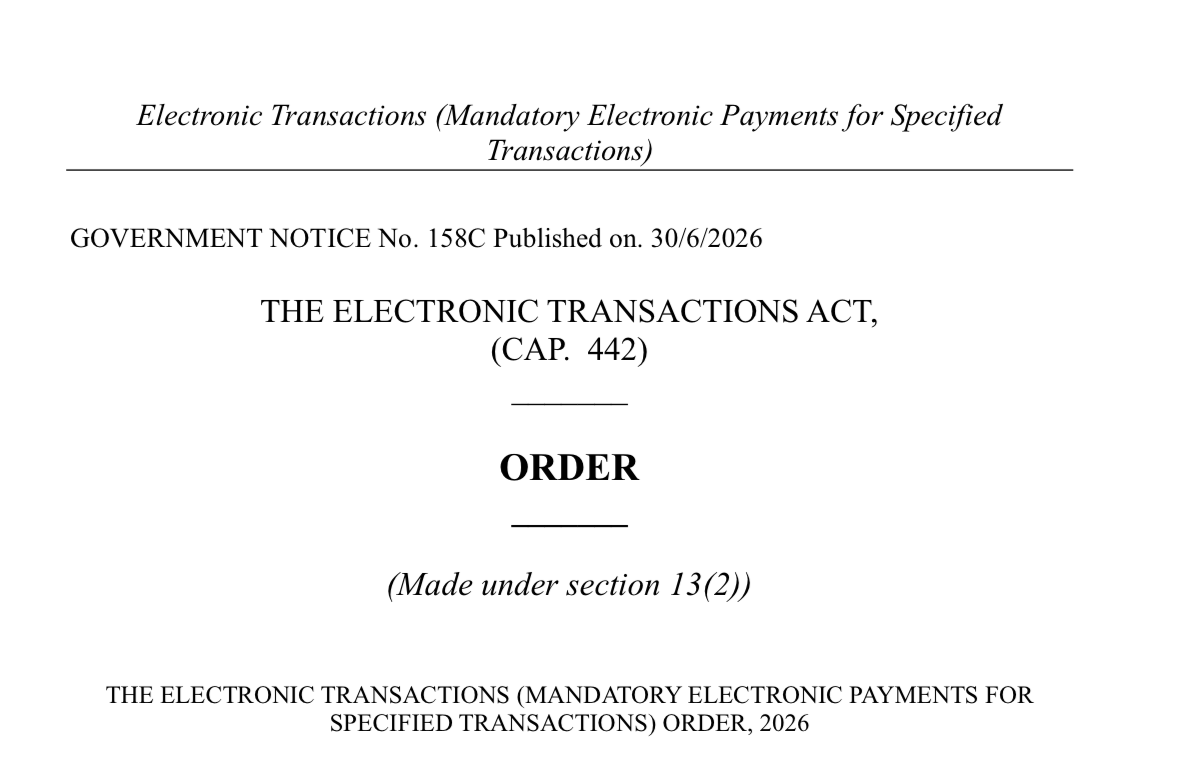
From 1 July 2026 the law for mandatory electronic payments for specified transactions was passed by the Finance Act of 2026 making it mandatory for the payers and receivers to use the identified electronic means to effect the their transaction. This came as a move of minimising use of Cash in most of the transactions within the United Republic of Tanzania.
The Government notice No. 158C Published on. 30/6/2026 introduced the Order for mandatory electronic payments for specified transactions where it defines the electronic means used for making payments as “means a method, system or channel of making or receiving payment through electronic or digital technology, and includes mobile money, bank transfer, electronic funds transfer, payment card, electronic wallet, point of sale device, internet or mobile banking or Government electronic payment system.”
With new amendments physical cash is no longer permitted for:
- Public & Passenger Transport: Payment of fees, charges, levies, tolls or fares in respect of bus rapid transit services (BRT)/Mwendokasi), ferries, bridges, long-distance passenger bus services, online taxi services, air transport, railway transport and parking services.
- Hospitality & Food: Payment for accommodation, food and beverages in hotels, restaurants and cafes. Payment relating to tourism-related services.
- Retail & Entertainment: Payment for goods or services in shopping malls, gymnasium, cinema theatres, filling stations, conference and event venues, sports arenas and international trade exhibitions such as Saba Saba and Nane Nane.
- Education: Payment of fees and contributions for educational services in pre-primary, primary and secondary schools, tertiary institutions and universities. Payment of contributions for educational services in tertiary institutions and universities.
- Real Estate: Payment relating to renting, sale or purchase of a building, plot or farm.
- Motor vehicle purchase and sale: Payment for motor vehicle sale or purchase.
- Agriculture: Payment relating to agricultural activities undertaken through cooperative unions and Agricultural Marketing Cooperative Societies (AMCOS) in respect of strategic crops (including cotton, cashew nuts, coffee, tea, sisal, and tobacco) as well as agricultural inputs and pesticides.
Transition Period & Non-Abolition of Cash : A person who, immediately before the commencement of this Order, was receiving payments in respect of a specified transaction shall, within six months, put in place electronic payment means in accordance with this Order. This Order shall not affect arrangements or contract relating to any transaction made before coming into force. The Tanzanian shilling remains legal tender. Cash is not abolished nationwide for all casual transactions, but it is prohibited for the specific schedule of commercial and administrative payments.
The new amendments will create a new wave of increase of income identification increased tax base and real time income identification by the Government where many transaction flowing through these key sectors of Transportation, Real estate, Education, Hospitality and Tourism will be captured through electronic means. Combating of financial crime (AML/CFT) will also be achieved, increased tax disputed resolution through available digital foot prints/payment proofs, formalising the informal sector to formal sector etc.
On other hand the amendment will introduce new costs to the implementers such as costs of introducing infrastructure and network reliability risks such as System Outages: electronic payment systems depend on reliable cellular networks, internet connectivity, and electricity. Network downtime at a filling station, bus terminal, or restaurant can completely stall transactions. Rural disparities: urban areas like Dar es Salaam have robust connectivity, but rural areas face unreliable mobile network coverage and power stability. Shifting millions of daily transactions to digital channels elevates the risk of mobile money scams, SIM-swapping, phishing, and cybersecurity vulnerabilities for both consumers and businesses.
Improving all these and having strong strategy of ensuring all means and process goes well will enable the full implementation of the electronic payment which is one of the better and easy way of making payments, making use of minimal time in getting services and moving goods and enabling the Government to collect more funds to finance the public needs.
For Tax consultation, Advisory or Compliance service contact through;
Call/WhatsApp + 255 795 75 9130
Email: info@elvinconsulting.co.tz


